TWO:Still, taking it altogether, the life of Aristotle gives one the impression of something rather desultory and dependent, not proudly self-determined, like the lives of the thinkers who went before him. We are reminded of the fresh starts and the appeals to authority so frequent in his writings. He is first detained at Athens twenty years by the attraction of Plato; and no sooner is Plato gone, than he falls under the influence of an entirely different character¡ªHermeias. Even when his services are no longer needed he lingers near the Macedonian Court, until Alexander¡¯s departure leaves him once more without a patron. The most dignified period of291 his whole career is that during which he presided over the Peripatetic School; but he owes this position to foreign influence, and loses it with the temporary revival of Greek liberty. A longer life would probably have seen him return to Athens in the train of his last patron Antipater, whom, as it was, he appointed executor to his will. This was just the sort of character to lay great stress on the evidentiary value of sensation and popular opinion. It was also the character of a conservative who was likely to believe that things had always been very much what they were in his time, and would continue to remain so ever afterwards. Aristotle was not the man to imagine that the present order of nature had sprung out of a widely different order in the remote past, nor to encourage such speculations when they were offered to him by others. He would not readily believe that phenomena, as he knew them, rested on a reality which could neither be seen nor felt. Nor, finally, could he divine the movements which were slowly undermining the society in which he lived, still less construct an ideal polity for its reorganisation on a higher and broader basis. And here we at once become conscious of the chief difference separating him from his master, Plato.114
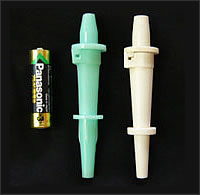
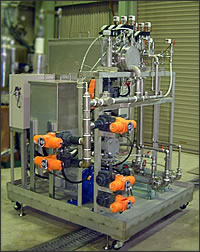
A hydrocyclone (liquid cyclone) injects treatment solution into stationary equipment to perform separation, classification, and concentration, and is an innovative separator with a very simple structure and no drive unit.
Structure of a hydrocyclone (liquid cyclone)
A suspension containing fine particles of several micrometers or more is supplied to a cylindrical container circumferentially at high speed. And as a result it starts to rotate and a centrifugal force is generated. At this time a gravitational acceleration of several tens of thousands of G is generated in the circumferential direction, and thus leading to fast sedimentation and concentration of the fine particles. The separated concentration can be freely selected by changing the supply rate (supply pressure and flow rate) and the flow ratio of the outlet. Our hydrocyclone (liquid cyclone) was designed and manufactured to classify and concentrate fine particles, and so has a small element.
THREE:In the last chapter we dealt at length with the theories of art, and especially of tragic poetry, propounded in Aristotle¡¯s Poetics. For the sake of formal completeness, it may be mentioned here that those theories are adapted to the general scheme of his systematic philosophy. The plot or plan of a work answers to the formal or rational element in Nature, and this is why Aristotle so immensely over-estimates its importance. And, just as in his moral philosophy, the ethical element, represented by character-drawing, is strictly subordinated to it. The centre of equilibrium is, however, not supplied by virtue, but by exact imitation of Nature, so that the characters must not deviate very far from mediocrity in the direction either of heroism or of wickedness.
- Equipment costs can be reduced.
- Operating costs can be reduced.
- Maintenance costs can be reduced.
- Any change in raw material and product can be easily addressed.
- Large amounts can be treated in a small area.
- Separation and cleaning are easy because of the simple structure.
- Simplified control
- This equipment can be operated in synchronization with external devices.
- Alarm and interlock mechanism.
THREE:For compasses, the lead points should be cylindrical, and fit into a metal sheath without paper packing or other contrivance to hold them; and if a draughtsman has instruments not arranged in this manner, he should have them changed at once, both for convenience and economy.
- Classification and concentration for the manufacture of inorganic powder materials
- Classification of ceramic materials
- Removal of fine particles, including iron powder
- Removal of fine particles from pigments
- Removal of fine organic particles from solvents
- Separation of starch and yeast
- Removal of fine particles from high-temperature strong acid solutions
- Removal of fine particles from low-temperature solutions